
weaving the pantry
 Weaving the pantry, a territorialized food governance model for La Merindad de Sangüesa It aims to promote the transition to sustainability for the local food system, through a co-government system.
In this way, it intends Involve all links in the agri-food chain, from production, through transformation, distribution and marketing, to reaching consumers.
weaving the pantry has the financing of the Daniel and Nina Carasso Foundation, through the call for projects of “territorialized food systems”.
New
Why weaving the pantry?
During the 2020 pandemic, the towns and inhabitants of the Merindad de Sangüesa were aware of the dependence of the outside for the supply of basic necessities. The reasons for this dependency: the absence of products or the lack of knowledge of the local product.
The need became a challenge, and this, an opportunity to evolve towards a sustainable system with the environment, and economically fair, that empowered those who live in rural areas, promoting the viability of our peoples and avoiding depopulation.
Among all the resources, food was chosen as a starting point. A Healthy, sustainable, rich and local food, which integrates waste management, closing the cycle of the circular economy. and focused on people, both those who work in the agri-food sector, and those who consume the final product.
In this initiative, associations and municipalities from La Mercidad de Sangüesa were involved, as well as the Entretantos Foundation, which carried out an operational diagnosis of the Agrolimentary System of the Sangüesa region, on which the rest of the initiatives of weaving the pantry have been developed.
Who promotes weaving the pantry?
Initially, the project was promoted by the municipalities of Esparza de Salazar, Urroz Villa, Burgui and Ustárroz, to which Cederna Garalur and the Gu Pirinioa project joined. Subsequently, another 27 municipalities as well as the following entities have been added:
- IRATI RSU ASSOCIATION.
- Association of Services of Sangüesa.
- Association of Social Services of Auñamendi.
- RSU EZKA-SALAZAR COMMUNITY.
- Board of the Roncal Valley.
- Aezkoa Valley Board.
- Twenty municipalities of La Merindad de Sangüesa.
- Arterra Bizimodu Association.
In addition, the strategy is coordinated from the Entretantos Foundation.
What is your financing?
Weaving La Despensa has the financial support of Cederna Garalur, the Innova Program promoted by Fundación Caja Navarra and Fundación “La Caixa” and the Daniel and Nina Carasso Foundation through its call for Territorialized Food Systems 2022.

In addition, the project has the economic support of the Cederna Garalur association, Gu Pirinioa/Somos Pirineo, as well as local public entities and the collaboration of various associations of the Merindad de Sangüesa, as well as the technical support of the Entretantos Foundation.
Why weaving the pantry?
- To structure local distribution networks of agri-food products
- To generate a food system that strengthens the local food chain in terms of sustainability
- to develop a territorialized food co-government system around the agri-food sector.
For whom weaving the pantry?
weaving the pantry poses a set of actions that They imply the entire population as well as the public, social and economic entities of the Merindad de Sangüesa, To promote a transition to a sustainable local agri-food system:
- Agrarian and livestock sectors, protagonists of many of the performances.
- Agrifood transformation facilities.
- Food distribution and trade.
- Hospitality and tourism.
- consumers and consumers.
- School canteens, nursing homes, food banks and other collective food equipment.
- associations and local entities.
- local administrations.
Milestones of weaving the pantry
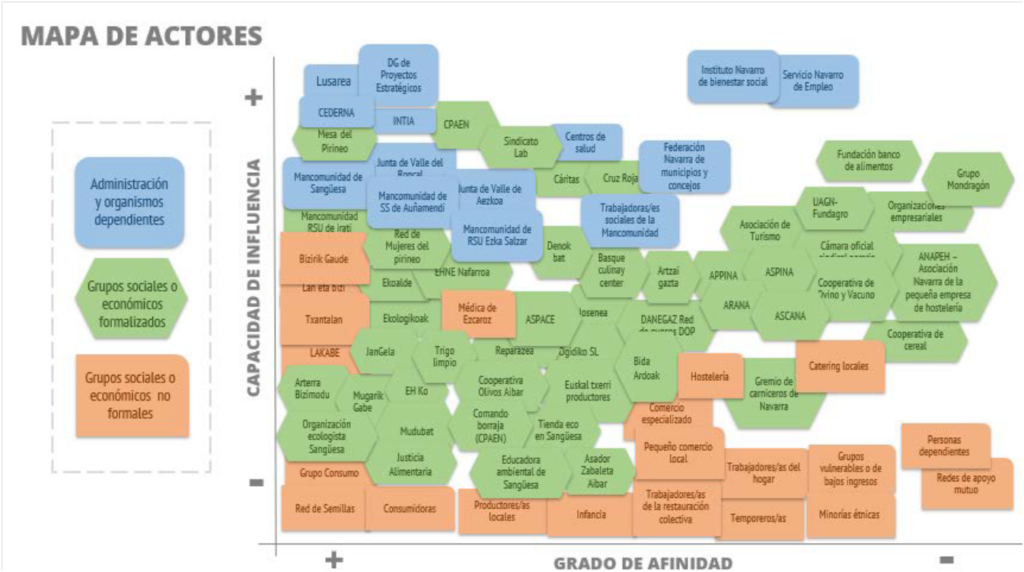
- 2020: Preparation of a participatory and operational diagnosis of the local food system of the Merindad de Sangüesa.
This diagnosis collects previous studies, plans and diagnoses and prioritizes actions in the short and medium term.
This study was presented publicly in 2021 together with an executive summary, and has served to launch the working groups, within the framework of which particular actions are identified and developed.
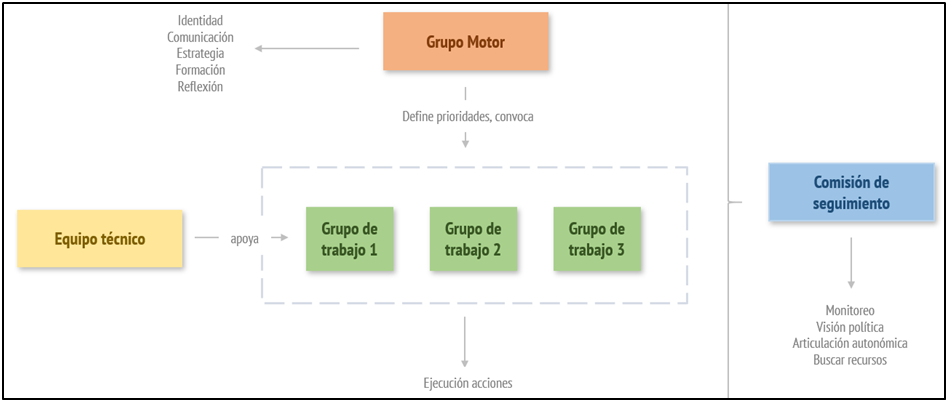
- March 2021. Creation of the Motor Group of the Project.
Composed of local development agents from Cederna Garalur and representatives of public, economic and social entities of the territory.
Hold online meetings with monthly frequency and face-to-face meetings every three months.
- May 2021: Creation of working groups.
GT1: Production; GT2: Hospitality and Commerce. GT3: Enhancement of the territory and shared identity. - End of 2021: Commissioning of the Monitoring Commission.
Made up of public entities of regional scope that work in the Merindad de Sangüesa on issues related to our project. The objective of this Commission is to build a coordination framework for the administrative and financial context of weaving the pantry.
What are weaving pantry work groups?
The working groups are responsible for materializing the actions and proposals prioritized in the initial diagnosis. The groups are thematic and consequently involve in each case very specific sectors. The working groups regularly hold online meetings, as well as a quarterly face-to-face meeting.
These are the working groups, their objectives and functions:
The working groups are responsible for materializing the actions and proposals prioritized in the initial diagnosis. The groups are thematic and consequently involve in each case very specific sectors. The working groups regularly hold online meetings, as well as a quarterly face-to-face meeting.
GT1. Production
farmers and ranchers.
Objectives:
- Define how to promote the distribution and marketing of the local product effectively.
- Discuss how to promote direct sales markets in La Merindad de Sangüesa.
- Strengthen cooperation and collaboration between the production sector (primary and secondary).
Performances:
- Define how to promote the distribution and marketing of the local product effectively.
- Discuss how to promote direct sales markets in La Merindad de Sangüesa.
- Strengthen cooperation and collaboration between the production sector (primary and secondary).
GT2: Hospitality and Trade
Objectives:
- Define how to promote the distribution and marketing of the local product effectively.
- Discuss how to differentiate trade, hospitality and catering establishments based on the commercialization of the local product, to increase the volume of sales and retain local consumption and tourism.
- Strengthen cooperation and collaboration between the distribution, trade, catering and hospitality sector, as well as between them and the producing sector (primary and secondary) in the Merindad de Sangüesa.
Performances:
- Differentiate the local small business and hospitality based on the local product, so that it allows its convergence in the Sangüesa Merindad.
- Prepare and make visible a list of establishments that offer local products.
- Prepare a catalog of local products available, together with GT1.
- Organize professional meetings between the production sector and the sectors of commerce, tourism and hospitality, together with the GT1.
GT3: Enhancement of the territory and shared identity
Objectives:
- Identify symbolic and cultural elements that allow to generate a shared identity in the territory of Merindad Sangüesa
- Define how to promote the feeling of belonging and cooperation between agents and social and economic entities in the territory.
- Identify how to promote the consumption of local food in the territory.
- Identify how to value the professional work of the production sector (primary and secondary) in the territory.
- Design strategies and concrete campaigns to strengthen a shared territorial identity in the Merindad de Sangüesa, increase the consumption of local food, and value the agricultural and agri-food activity.
Performances:
- Develop and launch a project communication plan by weaving the pantry, including corporate image, slogans and communication actions.
- Said plan will in turn start the work to generate a shared identity in the territory and the promotion of local consumption of food produced in the territory.
- Attract more public and social entities to get involved in the project
I want to participate, how do I do it?
In weaving the pantry is Participation and contributions are essential of individuals, companies, associations, school canteens, professionals from the agricultural sector, municipalities. Therefore, we invite you to collaborate in many ways:
If you are a local entity:
- getting involved in the work groups.
- Contacting our project to solve doubts and establish coordination.
- Disseminating the pantry through your communication channels: Web, WhatsApp broadcast listings, social networks, bulletin boards.
- helping us to convene fairs and public events related to our project.
- facilitating the use of municipal premises for project activities.
- facilitating the updating of data for the development of the actions contemplated in the project.
- Linking the local agenda 21 with weaving the pantry.
If you are an individual association, company or person:
- Participating in the work groups of weaving the pantry.
- Collaborating in the organization of activities within the framework of our project.
- participating in these activities.
How can I contact?
Through Cederna Garalur:
Cederna.eu
weaveladespensa@cederna.es
Through:
- the Commonwealths
- Valley joints
- Cederna Garalur Local Development Agencies